Lessons from the Storm
Sometimes a storm teaches you something the gym never did. The story behind one of the most functional movements in the FACETS toolkit.
Hurricane Helene nearly ruined our Homecoming weekend. Trees down everywhere around the AirBnB, the kind of damage that arrives fast and leaves slowly. The homeowner called in a tree cutting crew and they showed up and did what tree crews do — reduced big impossible things into smaller manageable ones. What was left behind was a field of tree blocks, each one weighing somewhere around 15 pounds, scattered across the property and needing to move.
Four men over 50 went to work. No gym equipment. No programming. No sets and reps. Just blocks, arms and a place near the side of the makeshift road to walk them to. We carried those blocks for the better part of an hour — picking each one up at chest height, walking it to the roadside, setting it down and going back for the next one. Nobody called it a workout. The body didn’t care what we called it.
I’ve been mimicking that movement with a kettlebell ever since. I call it the goblet carry.
What the Goblet Carry Actually Is
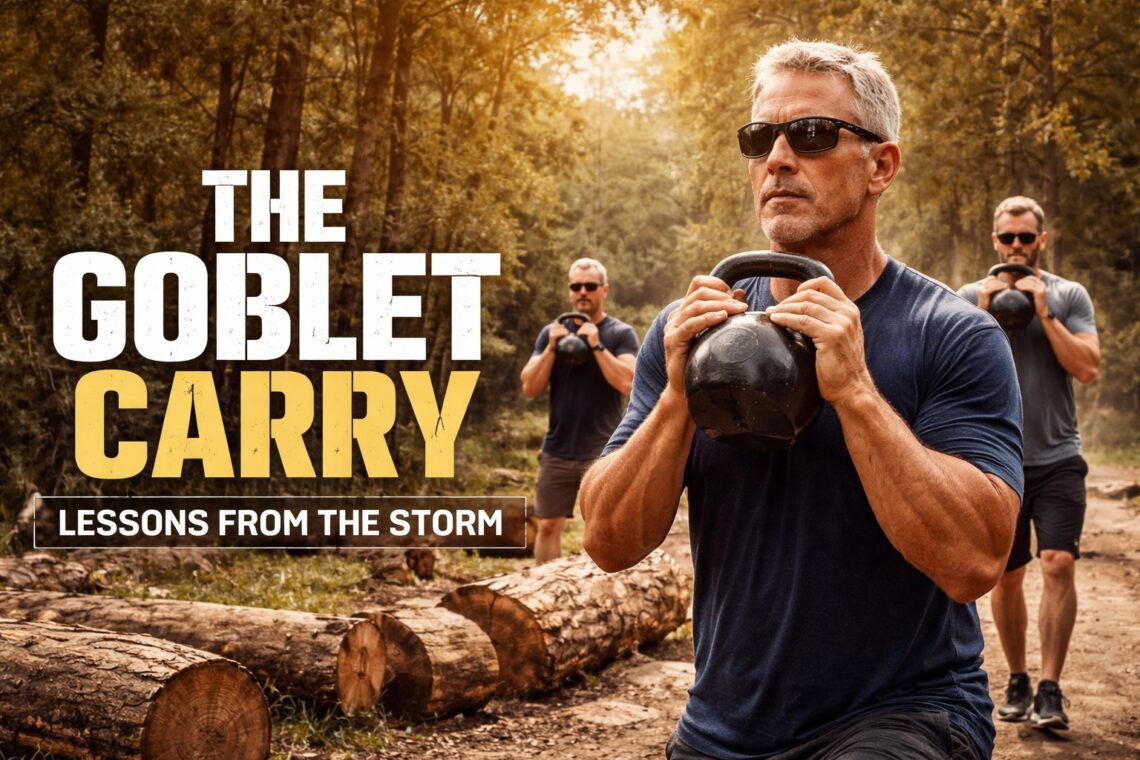
The execution is simple enough to explain in a single sentence. Hold the kettlebell at chest height in the goblet position — both hands cupping the bell, elbows pointed down, the weight close to the body — and walk with it. That’s the complete movement. What happens inside that simplicity is considerably more complex.
The forward load at chest height creates a constant pulling force that the core has to resist to keep the torso upright. The moment the core stops working the body pitches forward and the carry becomes uncomfortable. Every step is therefore a core stability challenge disguised as transportation. The tree block crew didn’t know they were doing core work for an hour. They were just carrying wood. The body made no such distinction.
The Goblet Carry — Full Demand Profile
Core
Resisting the forward pull of the chest-height load continuously throughout the carry. Anti-flexion core work that no crunch or sit-up replicates in the same functional context.
Upper Back
Rear deltoids and rhomboids working to prevent the shoulders from rounding forward under the load. Postural strength built through sustained real world demand.
Grip and Forearms
Continuous offset load management from the moment the bell leaves the floor to the moment it returns. The offset loading principle operating through every step of the carry.
Legs and Glutes
Carrying both body weight and the bell through a dynamic walking pattern. Every step is a single leg loading event under total load. The posterior chain is involved whether it volunteered or not.
Cardiovascular System
Sustained loaded walking elevates the heart rate meaningfully above unloaded walking. The caloric output of a goblet carry session exceeds a comparable walking distance without load by a significant margin.
The Blacksmith Principle Returns
There is a recurring theme in this training journey that keeps arriving from unexpected directions. The blacksmith at his anvil. The tree block crew on a storm-damaged property. Functional labor producing fitness as a byproduct of purposeful work. Nobody programs the blacksmith’s training. Nobody designs the tree crew’s workout. The body simply responds to consistent, purposeful, loaded movement the way it was designed to respond — by getting stronger, more capable and more durable.
The Lesson Hurricane Helene Delivered
Fitness doesn’t always come from a program. Sometimes it comes from a storm, a crew, a field of tree blocks and four men over 50 who showed up and did the work without being asked. The kettlebell is just the civilized version of the tree block.
The goblet carry is that principle in its most direct form. Pick up the weight. Hold it close. Walk with it. Put it down. Go back for the next one. The gym has a name for this. The tree crew just called it clearing the yard.
The Goblet Family
The goblet carry joins a growing family of movements in the FACETS toolkit that share the same foundational position — weight held at chest height, close to the body, demanding constant upper body and core engagement as the foundation for whatever movement follows.
Goblet Squat
The anchor of the daily PSC baseline. Weight at chest height loading the squat pattern, deepening hip mobility and building lower body strength with the upper body fully engaged throughout.
Goblet Carry
The newest addition. Weight at chest height moving through space. Core resisting forward pull. Upper back maintaining posture. Legs and cardiovascular system accumulating work with every step.
Goblet Hold
The isometric foundation of the family. Weight at chest height held stationary. Pure anti-flexion core work and upper back endurance. The tree block position sustained until the muscles have said their piece.
Each member of the family draws from the same position and demands the same foundational engagement. Together they represent a complete upper body isometric and core stability system built around one of the most natural load-bearing positions the human body has ever used — carrying something heavy close to the chest.
Why Functional Training Has Roots
The best movements in any training practice tend to have origins outside the gym. The swing comes from the ballistic labor of the blacksmith and the farmer. The carry comes from every human who ever moved something heavy from one place to another. The squat comes from a resting position that modern furniture has nearly eliminated from daily life.
The goblet carry comes from Hurricane Helene, a Homecoming weekend, a tree cutting crew and four men over 50 who spent an hour doing something that needed doing. The kettlebell just makes it repeatable, scalable and available on any day regardless of whether a storm has recently delivered tree blocks to the yard.
Functional training has roots. The more honestly those roots are traced the more useful and sustainable the training becomes. The body recognizes movement that comes from real work. It responds to it differently than it responds to movements invented for a machine in a gym.
The kettlebell is just the civilized version of the tree block. The movement is older than the equipment.
How to Run the Goblet Carry
The execution requires almost no instruction beyond what the tree block crew demonstrated naturally. Pick the bell up into the goblet position. Stand tall. Walk with deliberate, controlled steps. Keep the elbows down and the bell close. Let the core do its job without thinking about it — the forward load will demand the engagement automatically.
Distance and duration are the primary variables. Start with thirty to forty feet and build from there. The goblet carry works beautifully as a transition between sets of other movements — carry the bell from one training position to the next rather than setting it down and picking it back up. Every step between exercises becomes a loaded carry. The session accumulates volume without adding a single dedicated set.
It also works as a standalone conditioning tool on lighter days when the body wants movement without the demand of ballistic swing work. Walk the hallway. Walk the yard. Walk the neighborhood with the bell at chest height and let the body remember what four men over 50 figured out during a storm — that carrying something purposefully is one of the oldest and most honest forms of physical training available.
Pick it up. Hold it close. Walk with it.
The storm already taught you how.
Discover more from Pat & Charlie
Subscribe to get the latest posts sent to your email.

Paul A. Jones, Jr.
Paul A. Jones, Jr. is a systems architect for human performance. He is the creator of FACETS, a framework for balanced daily living forged from nearly 30 years in software development and advanced degrees in Physics and Engineering. He writes from the control room of his own practice—where data meets the daily rhythm of rucking, fasting, and mindful recovery. His “Pat & Charlie” network—named for his left and right feet—is his open-air gym, his laboratory, and his proof that wellness is a system that can be taught, lived, and transmitted with clarity and joy.

You May Also Like
Rucking: The Ultimate Wellness Protocol Hiding in Plain Sight
